Learn about the 3 reasons that make small apartments a highly profitable segment for residential automation.
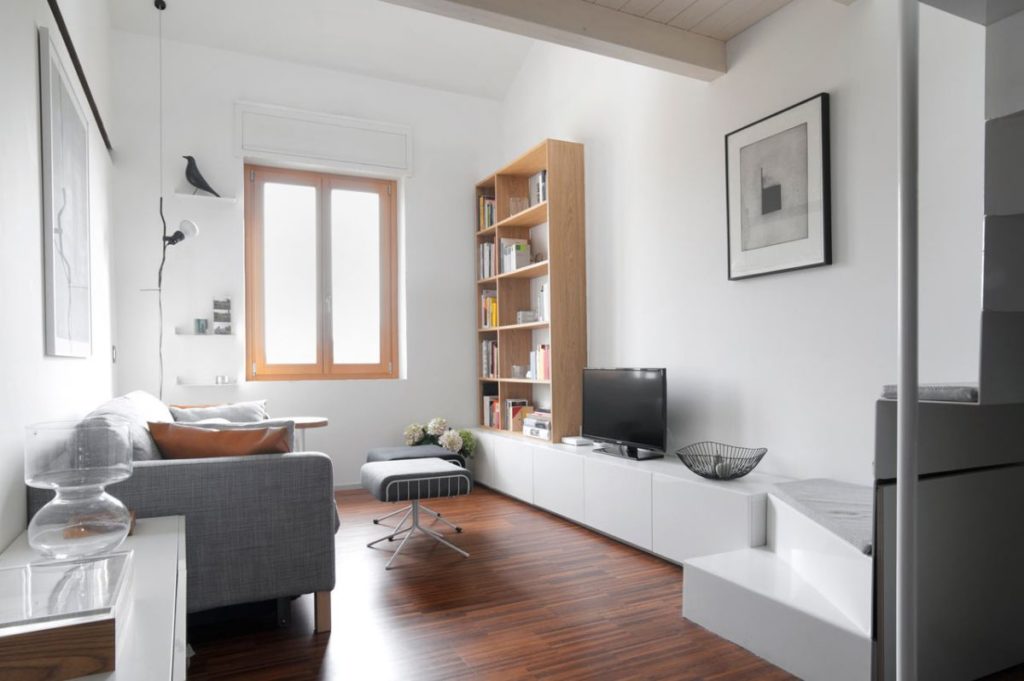
Small apartments are the newest niche in American construction.
What used to be less in real estate has become more and better. The growth of the small apartments market is a trend in America. Despite the crisis, this is a segment fully aligned with the new principles of sustainability and innovation.
Based on economical construction with an integrated environmental concept, the small apartments are units up to 550 ft² in size. Targeted at a demanding target audience, concerned about cost savings, they are an excellent area for the application of advanced residential technology.
Residential automation cooperates nicely with this new construction niche in America, for several reasons. By enabling the creation of intelligent systems for subsystem management, solutions can reduce energy costs by 30%! Not only that, but the technological capability and flexibility offered by wireless systems make residential automation more accessible.
Want more reasons why you should become an integrator and offer these solutions ? Check out these three tips to invest now in the home automation market!
In this post you will learn about
- What are the target audiences of compact apartments?
- Why wireless automation is perfectly aligned with the concept
- How Builders Benefit from the Use of Automation in Their Enterprises
GROWING TRENDS AMONG MORE “ALONE”
The growth of interest in small apartments prove a reality: Americans increasingly want to live alone. According to the U.S Census, about 28% of Americans live alone.
In addition, the national association of REALTORS survey showed that 32% of the Millennials showed an interest in acquiring their own property. With emphasis on the main benefit to this practice, independence was highlighted. Also a staggering amount of the older generation is living alone. This opens up the possibility to introduce assistive domotics to help them.
In another hand, the audience targeted as “target” the trend is opposite. According to the United States Census, one in three young adults (18 to 34 years) live with their parents. The so-called “Boomerang generation”, who is returning to live with the parents. Among the main factors are professional and economic instability, the decision to marry later, and other priorities.
These data reveals some opportunities to be explored in compact apartments in the coming years.
- Creation of specific products for adult couples and single residents;
- Compact apartments for “middle-aged” consumers (35-50 years);
- Development prioritizing reduction of costs of apartment administration
These factors make residential automation systems ideal for the intelligent management of the apartment’s physical space. Aimed at an increasingly educated mobile audience, the use becomes much more contextual and practical. From the centralization of load control through the adjustment of scenes, automation becomes very attractive to this consumer profile.
CREATION OF “LEAN AUTOMATION” WITH WIRELESS
The cost-benefit of automation is easily adapted to compact apartments, for long-term energy efficiency, but mainly for the cost of installation. By this factor, it is possible to meet the lower price differential to the consumer by creating complete projects through wireless automation.
First of all, the applicability of this type of “lean” automation is in support of the design of the apartment as an integrated environment.
This concept is based on the composition of the home space in a unique way. In it, all rooms are integrated or are created together, except for the bathroom and bedroom. In general, there is the complete or partial removal of walls and multipurpose design application. The compact apartment models are somewhat minimalist and functional in their furniture. To optimize the use of space, fixed shelves, various lighting, and mirrors are used in your decoration.
The lack of resources in the internal environments of the compact is complemented by a series of services aggregated in the outer space of the condominiums. For example, the availability of recreation areas and cleaning services. All through payment of condominium, a service categorized as pay-per-use .
However, the development of the project should be optimized in the long term for user-needs. This will require the observation of basic principles at the time of installation.
- Interoperability: connection to IOT devices, through flexible communication protocols;
- Scalability: be flexible for expansion of auxiliary subsystems, such as residential security;
- Valuation of the property in the long term;
- Ability to customize, allowing maximum resources within the contracted budget.
Observing these characteristics, it is up to the integrator to make the compact apartment a sustainable construction. This means for the energy efficiency and use of light. Developing an integrated project remains the most appropriate option to avoid future problems.
DIFFERENTIATION OF ENTERPRISE AND COST REDUCTION TO THE CONSTRUCTOR
The small apartments are still considered niche products by the real estate market. However, with the housing crisis, the builders turned their eyes to small buildings. With the reduced cost to finance these works and a target audience with lower average ticket, the apartments have become a profitable source to be explored.
We have already touched on here as buyers’ concern with cost-benefit is a central point in the acquisition of these apartments. However, the price reduction does not take away the need for smart technology at home. Therefore, the use of wireless automation emerges as a differential that combines sustainability and cheap installation.
Previously, we highlighted how builders are more attentive to the issue of the lowest price to enable the installation in their ventures. In general, the acquisition is made directly to the manufacturer or integrator, standardized system environment, which reduces the total cost in a single billing. For the professional, the gain comes in two forms.
- Installation, in direct sale of the solution to the construction company;
- Indication of the service by the manufacturer, on the occasion of a direct purchase by the construction company.
Today the use of wireless systems, represent about 1% of the total cost of work. In the coming years, costs tend to fall even further with the popularization of these low-end automation solutions.
The benefits of its use go well beyond the feasibility of reducing the total cost of the work. They represent a brand gain to be exploited by the developers. The association with technology, as well as mobility and price, is a relevant factor especially for the younger audience.
Through the flexibility of the developed projects, the gains of the integrator can be even greater. More standardized systems can be expanded in the future by incorporating new features for audio, video and lighting. In this way, customers will pay for individual services to expand and maintain their automation.
If you enjoyed this post please feel free to share it on your social media pages! We always appreciate the gesture and it helps get great content out to more people!